
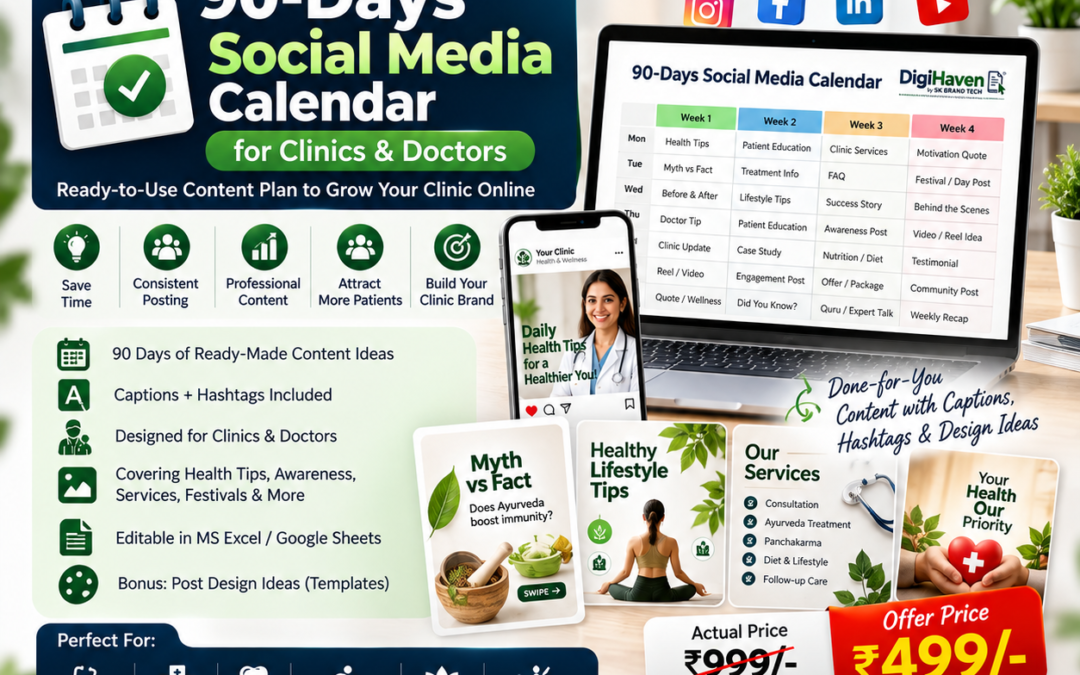
90-Day Clinic Social Media Calendar: A Complete Guide for Doctors & Small Clinics
Social media has become an important communication channel for doctors, clinics and healthcare professionals.
Patients increasingly use platforms such as Instagram, Facebook and Google to discover healthcare providers, learn about health topics, understand available services and decide which clinic they may want to contact.
But maintaining a consistent social media presence is not always easy.
A doctor may have patients waiting, consultations to complete, procedures to perform, staff to manage and administrative responsibilities to handle.
Then comes the question:
"What should I post today?"
And tomorrow?
And next week?
And three months from now?
This is where a clinic social media calendar can make a significant difference.
A well-planned 90-day social media calendar for doctors and clinics provides a structured content plan so that healthcare professionals can consistently publish useful, educational and trust-building content without having to think of a new idea every day.
In this guide, we'll explain:
-
Why social media matters for clinics
-
Why doctors struggle with consistent content
-
What a clinic social media calendar is
-
What types of content clinics should post
-
How to create a 90-day content strategy
-
The seven important content pillars for clinics
-
The three phases of a clinic content strategy
-
How to use health awareness days
-
How to measure social media progress
-
Common social media mistakes doctors should avoid
-
How a ready-made 90-day clinic social media calendar can simplify the process
Why Is Social Media Important for Doctors and Clinics?
A clinic's online presence is often one of the first places potential patients look before contacting the practice.
A professional social media presence can help clinics communicate information about:
-
Services
-
Doctors
-
Areas of expertise
-
Health education
-
Clinic facilities
-
Patient care approach
-
General wellness information
-
Appointment information
-
Awareness campaigns
Social media should not replace appropriate medical consultation. Instead, it can serve as a communication and educational channel.
For a small clinic, consistent content can also help build familiarity with the clinic over time.
The Biggest Social Media Problem for Small Clinics
Most doctors don't have a lack of expertise.
They have a lack of time.
A typical doctor may know hundreds of useful health topics but may not have the time to turn those ideas into social media posts.
Creating one post involves several separate tasks:
1. Finding a topic
What should you talk about?
2. Creating the visual
What should the graphic or carousel show?
3. Writing the caption
How should the information be explained?
4. Finding hashtags
Which hashtags are relevant?
5. Scheduling the post
When should it be published?
6. Tracking the content
Was it actually posted?
When these tasks are repeated every day, social media management becomes another job.
A content calendar helps turn these individual tasks into a structured system.
What Is a Clinic Social Media Calendar?
A clinic social media calendar is a planned schedule of social media content created specifically around the needs of a healthcare practice.
Instead of deciding what to post every morning, the clinic plans content in advance.
A typical calendar can include:
-
Date
-
Day
-
Content topic
-
Content pillar
-
Post format
-
Visual direction
-
Caption
-
Hashtags
-
Platform
-
Publishing status
-
Notes
A 90-day clinic social media calendar takes this concept further by providing a three-month content framework.
Why Choose 90 Days?
Ninety days is long enough to establish a consistent content routine without making the planning process feel overwhelming.
Three months allows a clinic to:
-
Establish its online presence
-
Test different content types
-
Educate its audience
-
Communicate its services
-
Build familiarity
-
Create trust
-
Introduce appropriate calls to action
-
Review what content performs well
Instead of asking:
"What should we post today?"
the clinic can work from a larger strategy:
"What are we trying to achieve during these 90 days?"
The 3 Phases of a 90-Day Clinic Content Strategy
A strong clinic social media strategy should not be a random collection of posts.
The 90-Day Clinic Social Media Calendar follows three broad phases.
Phase 1: Get Known
Goal: Awareness
The first stage is about helping people understand who you are and what your clinic provides.
Potential content can include:
-
Doctor introduction
-
Clinic introduction
-
Services
-
Areas of expertise
-
Health education
-
Frequently asked questions
-
Clinic location
-
General wellness information
The objective is simple:
Help people discover and understand your clinic.
Phase 2: Build Trust
Once people know about your clinic, the next step is to consistently provide useful information and demonstrate a patient-focused approach.
Content can include:
-
Educational posts
-
Myth vs fact
-
Wellness advice
-
Doctor insights
-
Patient-care information
-
Behind-the-scenes content
-
Common questions
-
General health awareness
Trust should be built through useful and responsible communication rather than exaggerated claims.
Phase 3: Get Bookings
Once your audience is familiar with the clinic and its services, content can include appropriate calls to action.
Examples include:
-
Book a consultation
-
Contact the clinic
-
Ask about a service
-
Schedule an appointment
-
Visit the clinic
-
Learn more about a treatment
The purpose isn't to make every post promotional.
Instead, conversion-focused content is introduced as one part of a balanced content strategy.
The 7 Content Pillars for a Clinic
One of the biggest problems with healthcare social media is repetitive content.
Posting "Book an appointment" every day doesn't create a useful content strategy.
That's why a structured content calendar can divide posts into different content pillars.
1. Health Education
Educational content can help your audience learn something useful.
Examples:
-
Healthy lifestyle tips
-
Preventive health
-
Common symptoms
-
General health information
-
Nutrition basics
-
Sleep and stress
-
Frequently asked health questions
Example topic:
"5 Everyday Habits That Can Support Better Sleep"
The focus should be educational and appropriate for a general audience.
2. Our Services
Your audience cannot consider a service if they don't understand what your clinic provides.
Service-focused posts can explain:
-
What the service is
-
Who it may be relevant for
-
What the process generally involves
-
How patients can learn more
-
How to contact the clinic
Example:
"What Happens During Your First Panchakarma Consultation?"
3. Myth vs Fact
Healthcare contains a large amount of misinformation.
A Myth vs Fact format can be an engaging way to address common misconceptions.
For example:
MYTH: Every headache requires a painkiller.
FACT: Headaches can have different causes and should be assessed appropriately when persistent, severe or concerning.
The actual medical content should always be reviewed by a qualified healthcare professional before publication.
4. Wellness
Wellness content allows clinics to discuss broader healthy-lifestyle topics.
Examples:
-
Sleep
-
Physical activity
-
Nutrition
-
Stress management
-
Healthy routines
-
Preventive health
-
Lifestyle habits
This type of content can help your clinic communicate beyond individual services.
5. Trust & Care
Healthcare is personal.
Patients want to know more than just what a clinic treats.
They may also want to understand:
-
Who the doctor is
-
How the clinic works
-
What the patient experience is like
-
What values the clinic follows
-
How patients are supported
Content can introduce your approach to patient care without making unsupported claims.
6. Behind the Scenes
Behind-the-scenes content can make a clinic's online presence feel more human.
Possible topics include:
-
Preparing the clinic
-
Team introductions
-
Staff activities
-
Equipment
-
Clinic environment
-
Hygiene practices
-
Daily workflow
Always consider patient privacy before photographing or publishing anything from the clinic.
7. Book a Visit
Sunday or another selected day can be used for conversion-focused communication.
Examples:
-
Appointment reminders
-
Consultation availability
-
Service reminders
-
Contact information
-
Booking instructions
A clear call to action makes it easier for someone who is already interested to take the next step.
What Should a Clinic Post on Social Media?
A balanced healthcare content strategy can include several formats.
Educational Posts
Explain a useful health topic.
Carousel Posts
Break a topic into multiple slides.
Myth vs Fact
Address a common misconception.
Doctor Introduction
Introduce the people behind the practice.
Service Explainers
Explain what your clinic offers.
FAQ Posts
Answer common questions.
Wellness Tips
Share practical lifestyle information.
Behind-the-Scenes Posts
Show the clinic environment and team.
Awareness Day Posts
Connect relevant health topics with awareness dates.
Appointment Posts
Give interested patients a clear way to contact the clinic.
Why Doctors Should Avoid Posting Only Promotional Content
Imagine following a clinic that posts:
Book Now!
Call Now!
Visit Us!
Every day.
The audience receives very little educational value.
A better approach is to create a mixture of:
Education + Services + Wellness + Trust + Human Content + Appropriate Promotion
This creates a more balanced communication strategy.
Health Awareness Days for Clinics
Health awareness days can provide useful opportunities for relevant content.
Examples include:
-
World Heart Day
-
World Diabetes Day
-
World Health Day
-
Doctors' Day
-
World Cancer Day
-
World Mental Health Day
-
World No Tobacco Day
However, a clinic should not publish an awareness-day post simply because the date exists.
The topic should be relevant to the clinic and its audience.
A content calendar can make it easier to identify these dates in advance.
Why Local Content Matters for Clinics
Healthcare is often geographically relevant.
A patient may search for:
"dentist near me"
"Ayurvedic doctor in Nashik"
"Panchakarma clinic in Nashik"
"physiotherapy clinic near me"
This is why local information can be incorporated into clinic content.
A social media strategy can include:
-
City name
-
Local area
-
Clinic location
-
Service area
-
Local health events
-
Community activities
For example, a clinic in Nashik could naturally incorporate relevant local references such as:
#Nashik
alongside more specific and relevant healthcare hashtags.
Local hashtags should support the content rather than replace meaningful location optimization across the clinic's broader online presence.
The Importance of Consistency
One of the most common mistakes clinics make is inconsistent posting.
A clinic might publish:
5 posts this week → nothing for 3 weeks → 2 posts → nothing for a month
A content calendar creates a predictable workflow.
Consistency does not necessarily mean publishing every day.
It means creating a sustainable schedule that your clinic can realistically maintain.
How to Create a 90-Day Social Media Calendar for Your Clinic
You can create your own calendar using the following process.
Step 1: Define Your Audience
Identify the people you want to communicate with.
For example:
-
Existing patients
-
Potential patients
-
Families
-
Wellness seekers
-
Local residents
-
People looking for specific services
Step 2: List Your Services
Write down the major services your clinic offers.
For example:
-
Consultation
-
Panchakarma
-
Physiotherapy
-
Diagnostics
-
Preventive health
-
Wellness services
Step 3: Create Content Pillars
Divide your content into categories.
A simple framework can include:
Health Education
Services
Myth vs Fact
Wellness
Trust & Care
Behind the Scenes
Book a Visit
Step 4: Create a Weekly Rhythm
Assign content pillars to different days.
This removes the need to decide what category to post every morning.
Step 5: Create the Visual Direction
For each post, decide what the visual should contain.
For example:
Topic: Signs of dehydration
Visual: 5-slide educational carousel
Step 6: Write the Caption
The caption should explain the topic clearly and include an appropriate call to action when relevant.
Step 7: Add Hashtags
Use relevant hashtags based on:
-
Topic
-
Service
-
Specialty
-
Location
-
Healthcare category
Avoid adding irrelevant hashtags simply to increase the number of tags.
Step 8: Track Publishing
Mark each post as:
Not Started → In Progress → Posted
This gives your team visibility into what has been completed.
The Problem With Creating 90 Posts Manually
Creating 90 individual posts from scratch means repeatedly doing:
Topic research → visual planning → caption writing → hashtags → scheduling → tracking
That can become a significant administrative burden.
A ready-made content system can reduce the amount of planning required.
This is the idea behind the 90-Day Clinic Social Media Calendar by DigiHaven.
Introducing the 90-Day Clinic Social Media Calendar
The 90-Day Clinic Social Media Calendar is a ready-to-use content planning system created specifically for small clinics and doctors.
It contains:
90 Posts
Every day has a planned piece of content.
90 Visual Ideas
You know what the designer or Canva user should create.
90 Captions
You don't have to write every caption from scratch.
Hashtags
Hashtag sets are organized according to content pillars.
Automatic Personalization
Enter your clinic details once and relevant information updates throughout the calendar.
How the Smart Setup Works
The system uses 7 yellow setup cells.
You enter:
-
Clinic Name
-
Doctor
-
What You Offer
-
City
-
Phone
-
Timings
-
Start Date
Once these are filled, the calendar automatically updates relevant:
Dates + Captions + Hashtags
This means you don't have to manually replace your clinic name in 90 different captions.
What Happens If You Forget to Update the Details?
The calendar includes a status warning system.
If example details are still being used, the status cell can alert you.
This helps reduce the risk of accidentally publishing content containing placeholder or example information.
The 6 Sheets Inside the Calendar
The product is organized into six sheets.
1. Start Here
Includes:
-
Setup instructions
-
Usage steps
-
Weekly rhythm
-
Colour guide
-
Posting guidelines for doctors
2. Calendar
The main 90-day content schedule.
It includes:
-
Date
-
Weekday
-
Phase
-
Content pillar
-
Format
-
Platforms
-
Visual idea
-
Caption
-
Hashtags
-
Status
-
Notes
Today's row is highlighted, and content pillars are colour-coded.
3. Progress
The Progress sheet helps you monitor:
-
Today's post
-
Overall completion percentage
-
Status breakdown
-
Phase breakdown
-
Content pillar breakdown
4. Caption Bank
Contains editable caption templates with placeholders such as:
{Clinic}
{Doctor}
This gives you additional flexibility when customizing content.
5. Hashtags
Contains hashtag sets for each content pillar and automatically generates a local tag using your city.
6. Health Days
Includes 23 health awareness days that can be used to replace regular content when relevant.
Who Should Use a 90-Day Clinic Social Media Calendar?
This type of content system can be useful for:
Small Clinics
Especially clinics without a dedicated marketing department.
Individual Doctors
Doctors who want to maintain a professional online presence without spending hours planning content.
Ayurvedic Clinics
Useful for combining health education, wellness, Ayurveda and service-focused communication.
Panchakarma Centres
Can support educational and service-related content planning.
Clinic Marketing Teams
A structured calendar can provide a starting framework for content production.
Healthcare Entrepreneurs
Useful for organizing social media operations across a healthcare business.
Common Social Media Mistakes Doctors Should Avoid
1. Posting Without a Strategy
Random posts can make your social media presence inconsistent.
2. Making Every Post an Advertisement
Educational content should have a meaningful role.
3. Ignoring Patient Privacy
Never publish patient information, images or testimonials without appropriate permission and safeguards.
4. Making Unsupported Medical Claims
Healthcare content should be accurate, responsible and reviewed before publication.
5. Using Excessive Clickbait
Healthcare communication should prioritize clarity and responsibility.
6. Forgetting Local Visibility
A clinic should communicate where it operates and whom it serves.
7. Not Tracking Progress
If you don't track what has been published, maintaining a 90-day plan becomes difficult.
How Much Time Can a Content Calendar Save?
The exact amount of time saved will vary significantly depending on who creates the content, the clinic's approval process and how much customization is required.
The main benefit is not simply "saving hours."
It is reducing repeated decision-making.
Instead of asking every day:
What should we post?
your team can ask:
How do we create today's planned post?
That's a much simpler workflow.
A Simple Weekly Workflow for Your Clinic
Once your 90-day calendar is ready, your team can follow a simple routine.
Monday
Review the week's content.
Tuesday
Create or approve upcoming visuals.
Wednesday
Review captions.
Thursday
Prepare hashtags and platform formats.
Friday
Schedule upcoming posts.
Saturday
Review engagement and questions.
Sunday
Publish or prepare the week's booking-focused content.
The exact workflow can be adjusted according to your clinic's schedule.
Social Media Is a System, Not a Single Post
One excellent Instagram post won't build an entire clinic's online presence.
What matters is the combination of:
Consistency
Useful content
Professional communication
Relevant services
Trust-building
Clear calls to action
A 90-day content calendar provides the structure needed to bring these elements together.
Get the 90-Day Clinic Social Media Calendar
If you are a doctor or run a small clinic and don't want to spend every week wondering what to post, a ready-made content calendar can give you a practical starting point.
The DigiHaven 90-Day Clinic Social Media Calendar includes:
90 Posts
90 Visual Ideas
90 Captions
Hashtags
Automatic Personalization
Progress Tracking
23 Health Awareness Days
3 Strategic Content Phases
7 Content Pillars
All in one organized content planning system.
Regular Price: ₹999
Offer Price: ₹499
Save ₹500
Enter your clinic details once. Plan 90 days of content. Post consistently.
[Get the 90-Day Clinic Social Media Calendar →]
Final Thoughts
Social media marketing for doctors doesn't have to mean spending hours every day creating content.
The key is to build a repeatable system.
Start with your audience.
Define your content pillars.
Create a weekly rhythm.
Plan your content in advance.
Review your healthcare information.
Protect patient privacy.
Track your publishing progress.
And most importantly, focus on providing useful information rather than simply trying to sell.
A 90-day clinic social media calendar can turn an overwhelming content task into a structured workflow.
For small clinics and busy doctors, that structure can make maintaining a consistent online presence much easier.
Plan once. Personalize once. Publish consistently.
Frequently Asked Questions
What is a social media calendar for doctors?
A social media calendar for doctors is a planned schedule of healthcare-related content that helps doctors and clinics organize topics, captions, visuals, hashtags and publishing dates.
What should a clinic post on social media?
Clinics can publish educational health content, service information, wellness tips, myth-vs-fact posts, doctor introductions, behind-the-scenes content, awareness-day posts and appropriate appointment calls to action.
How often should a clinic post on social media?
There is no single schedule that works for every clinic. A consistent and sustainable schedule is generally more practical than posting frequently for a short period and then stopping.
Is 90 days enough for a clinic social media strategy?
Ninety days provides a useful planning period for establishing consistency, testing content categories and reviewing what resonates with an audience. It should be treated as a planning cycle rather than a permanent strategy.
Can doctors customize the social media calendar?
Yes. A customizable calendar allows clinics to add their clinic name, doctor name, services, location, contact details and timings and adapt content to their own practice.
Can a clinic use the same content on Instagram and Facebook?
Content can often be adapted across platforms, but formatting, audience behavior and platform features differ. A clinic should review and adapt each post before publishing.
Should doctors use health awareness days in social media marketing?
Relevant awareness days can provide useful educational content opportunities. Clinics should choose dates that genuinely relate to their specialty and audience rather than posting about every awareness day.
Does the 90-Day Clinic Social Media Calendar include captions?
Yes. It includes captions for the 90 planned posts, along with editable caption templates in the Caption Bank.
Does it include hashtags?
Yes. It includes hashtag sets organized by content pillar and an automatically generated local hashtag based on the city entered during setup.
Is this product suitable for Ayurvedic doctors?
Yes. Ayurvedic doctors can adapt the educational, wellness, service and trust-building content to their specific practice and services. All health-related content should be reviewed before publication.